How a Doctor’s Words Shape a Casino Drama
See how a doctor’s words shape a casino drama by tracing dialogue, scene changes and patient agency without confusing fiction with clinical guidance.
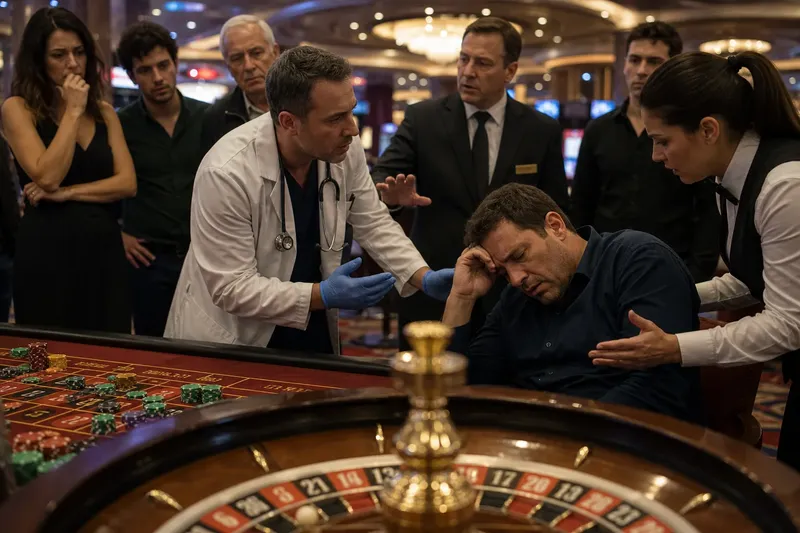
A roulette ball clicks towards its final pocket while a player slumps beside the table. The dealer calls for help, and the doctor’s first words can decide whether the scene treats the player as a person with choices or as a disruption to the game. For medical education at Trường Đại học Y Dược - ĐH Huế, this kind of close reading can open discussion about language and representation, not clinical practice.
Doctor dialogue in a casino drama can shift the scene’s priorities
Listen to what the doctor says, who is addressed and what happens after each line. A direct question to the player gives them a place in the exchange; an instruction delivered only to staff can make the player seem absent from their own scene. Neither choice tells us whether the fictional care is clinically sound, but each shapes the audience’s view of the encounter.
Words can also set competing priorities against one another. A request to make room, for example, may interrupt the casino’s routine, while a manager’s reply about the table can bring business pressure into the conversation. The sequence matters: note whether the doctor acknowledges that reply, redirects attention to the player or leaves the conflict unresolved.
Specific phrases reveal who holds authority
Imperatives, questions and forms of address carry different dramatic effects. “Move back” is an order; “Could you give us space?” is framed as a request; using a player’s name, if the scene has established it, can make the address more personal. These details do not prove anything about a real clinician’s manner. They show how a script distributes authority and attention.
Notice whether the patient can answer in their own words, ask for something, or disagree. If the doctor responds to that contribution, the dialogue gives it consequence. If another character answers on the patient’s behalf and the scene moves on, the script may be presenting the patient as less active in the exchange.
- If the doctor addresses the player directly, note whether the player gets a reply; if not, consider whether the dialogue sidelines them, and compare the next line that restores or further limits their voice.
- If the doctor asks a question, record who answers; if a manager or dealer answers instead, note whether the doctor then turns back to the player or continues through the intermediary.
- If the player makes a request, check what follows; if the scene changes in response, record the visible change, and if it does not, ask whether another character explains why.
- If the doctor gives an instruction, identify its recipient; if staff act on it, note how their action changes the scene, and if they do not, consider whether the script addresses the pause or leaves the instruction hanging.
- If a line is interrupted, identify who interrupts and what the next line concerns; if the conversation returns to the player’s point, note the recovery, and if it shifts to the casino’s business, consider which priority the script foregrounds.
- If the doctor uses a name or a form of address, check whether the player responds to it; if they do, note how the exchange develops, and if they do not, avoid claiming intimacy that the scene has not shown.
Language can show agency without making a clinical judgement
Agency in a scene means that a character’s words or actions have an observable effect on what happens next. It does not mean the character controls every outcome. A player may ask the crowd to move, while staff decide how to respond; the scene can still show whether the request is heard and acknowledged.
Say an invented scene begins with a player beside a roulette table, a dealer calling for help and a manager asking whether the game can continue. The doctor says, “Let’s make space,” then asks the player, “Would you like the crowd to step back?” The player says yes; the manager signals to staff, who move the onlookers away, and the camera holds on the player. The observable result is that the player’s answer precedes a change in the scene. If, instead, the manager answers for the player and the doctor turns away, the scene gives the player less visible agency. This comparison concerns the writing, not what real care should involve.
Word choice works alongside tone and interruption
A line’s meaning depends partly on its delivery. A calm question may sound reassuring, impatient or merely procedural depending on the actor’s tone, the pause before the answer and the reaction that follows. Keep the wording and performance distinct in discussion: the script supplies the line, while the performance shapes how it is heard.
Interruptions are especially revealing when they change whose concern is heard. A manager might begin to discuss the table, only for the doctor to redirect the conversation to the player. Alternatively, the player might begin speaking and be cut off by an announcement. Describe the exact turn and its consequence rather than assigning a motive that the scene does not establish.
How should viewers interpret a doctor’s dialogue?
Does a polite phrase make the fictional doctor caring?
Politeness can affect how a line sounds, but one phrase cannot establish the character’s full attitude. Look at whether the doctor listens, responds to the player’s words and changes the conversation when the player contributes.
What does it mean if the doctor speaks to the manager?
The dialogue may be showing coordination, conflict or a choice to keep the player out of the exchange. Check whether the doctor also addresses the player and whether the manager’s reply changes what follows.
Can a class judge whether the dialogue is clinically correct?
A drama can prompt questions, but dialogue alone is not a reliable basis for clinical instruction. For questions about real care, use relevant teaching materials and consult a qualified educator or clinician.
How can students discuss a line without guessing the character’s motives?
Quote or paraphrase the line, identify its recipient and describe the next observable action. Then distinguish that evidence from an interpretation, such as whether the line sounds protective or controlling.
A close reading stays with the words and their consequences
For a short classroom discussion, choose one exchange and record three things: the speaker, the person addressed and the next action. Add a note when a reply is interrupted or ignored, then separate what is visible from what you infer. This keeps attention on the doctor’s words rather than turning the scene into a checklist for real clinical behaviour.
It is not worth decoding every pronoun, pause or background remark as a hidden message. Focus on wording that changes who speaks, what the patient can express or what happens next; leave incidental dialogue alone unless the scene returns to it.
When students discuss a doctor’s words in a casino drama, the useful distinction is between dramatic effect and clinical guidance. The line can reveal who receives attention, who gets to answer and which priorities shape the scene. Keeping that distinction clear makes the conversation more precise—and leaves decisions about real care to qualified professionals.