Medical Education at Trường Đại học Y Dược - ĐH Huế Through the Lens of Casino Stories
Medical education at Trường Đại học Y Dược - ĐH Huế can be discussed alongside casino stories by separating documented teaching history from screen drama.
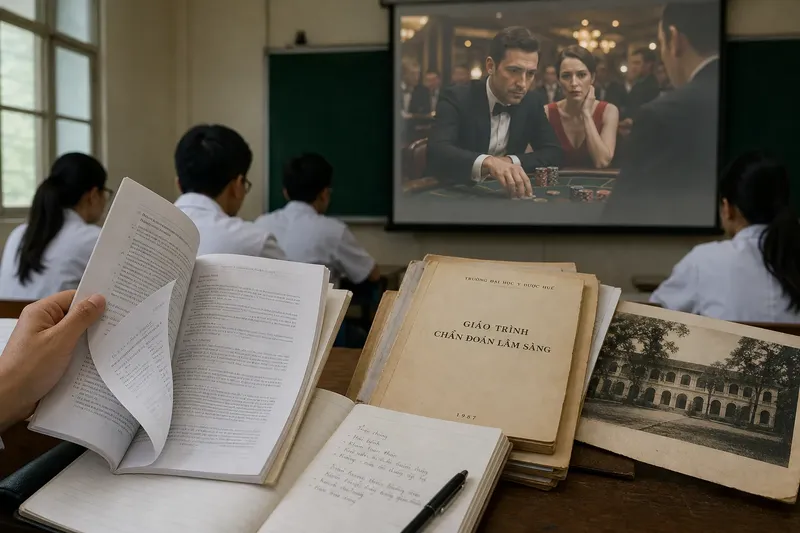
A student turns a page of lecture notes while a casino film plays on a classroom screen. The contrast offers a useful way to discuss medical education at Trường Đại học Y Dược - ĐH Huế: the film supplies a story about care, while the institution’s teaching history must be described from records that document it.
Medical education at Trường Đại học Y Dược - ĐH Huế needs a documentary account
The university’s teaching traditions cannot be responsibly reconstructed from a film scene or from broad assumptions about medical schools. A specific historical account needs sources tied to the institution, such as dated curricula, course descriptions, archived teaching materials, institutional publications and records of programme changes.
These sources answer different questions. A curriculum may show what subjects were listed; a teaching resource may reveal how a topic was presented; an institutional record may clarify when a programme or practice was documented. Until such material is consulted, it is more accurate to say that the history remains to be established than to attribute a particular method to Huế.
Casino stories frame care as a choice under pressure
A casino setting often places a game, a social relationship and a character’s decision in the same scene. The audience can observe who notices a problem, who responds and whether the game distracts from the person needing attention. That is a reading of the story’s choices, not a clinical assessment.
Medical education has a different purpose: learners need to distinguish observations from conclusions and consider what information is missing. A film can prompt that kind of conversation, but suspense may leave a symptom unexplained or make a character’s response serve the plot rather than model sound care.
A close reading can compare the two without inventing a link
Imagine a lecturer has a casino film scene and an archived teaching handout from a course at Huế. The handout names a topic but says nothing about the film. The lecturer can describe the handout as evidence of how that topic was taught, then discuss the scene as a separate cultural portrayal; without a source connecting them, the lecturer should not claim that the film inspired the lesson.
For a clear comparison, separate three layers: what the screen shows, what the teaching document records and what the writer infers. If the film gives no cause for a character’s complaint, leave it unresolved. If the handout documents a classroom exercise, report its wording and date as recorded, rather than extending it into an undocumented account of everyday teaching.
What can readers learn from comparing casino stories with Huế teaching history?
Can a casino film show how Huế medical students were taught?
Not on its own. A film can portray care or uncertainty, while claims about teaching at Trường Đại học Y Dược - ĐH Huế need institutional or educational records.
What records help establish a teaching tradition?
Dated curricula, course documents, archived teaching materials and institutional records can each support particular claims. A writer should state what a source documents and avoid treating one surviving item as proof of every classroom practice.
How should an unexplained symptom in a film be described?
Describe what the character says or does and note that the story leaves the cause unclear. Do not turn an ambiguous scene into a diagnosis or medical instruction.
When is it fair to say a film influenced a lesson?
That claim needs evidence connecting the film to the teaching material, such as a documented course resource or a reliable account of its use. If no such evidence is available, describe the resemblance as an interpretation rather than a historical connection.
Use a source-by-source check before making historical claims
Before writing a comparison, match each sentence to the kind of evidence that could support it. These checks help determine whether to state a claim, qualify it or leave it out:
- Check a claim about a course: if a dated curriculum names the course, describe that listing; if it does not, avoid presenting the course as documented.
- Check a claim about a teaching method: if an archived resource or record describes the method, identify the source and its scope; if it does not, call the method a possibility, not an established Huế tradition.
- Check a claim about the film’s plot: if dialogue or action shows a character seeking help, describe that action; if not, do not say help was sought.
- Check a claim about medical meaning: if the story states a cause, attribute that explanation to the film; if it leaves the cause open, preserve the uncertainty.
- Check a claim of influence: if a source directly connects the film to a lesson, describe that evidence; if the link rests only on resemblance, present it as an interpretation.
- Check a claim about historical change: if records from different periods document a change, describe only the change they show; if the records are incomplete or incomparable, qualify the account.
It is not worth assigning symbolic meaning to every casino prop. A roulette wheel may simply establish the setting; focus on details that the story actually connects to a character’s response or decision.
Keep the comparison useful and bounded
Casino stories can help readers notice how fiction frames attention, uncertainty and care. The history of medical education at Trường Đại học Y Dược - ĐH Huế is a separate subject, best told through dated institutional and teaching records, with each claim kept within what those records support.
For anyone searching for medical education at Trường Đại học Y Dược - ĐH Huế, the most useful comparison is therefore a disciplined one: describe the screen scene precisely, identify what the teaching sources establish and mark the space between them. That boundary makes room for thoughtful interpretation without turning a cinematic resemblance into institutional history.